How to Sink (on Purpose!) Your Floating 3DPrinted Parts (SCA Tank Tricks and Tips)

How to attach two small metal baskets to each other, to hold a large 3D printed part inside a Support Cleaning Apparatus tank.

Ever print a filament-based part with soluble supports, that just wants to float in your tank? By tank, I mean the Support Cleaning Apparatus (SCA) tank offered by Stratasys that dissolves away support material that has been printed with one of the Stratasys FDM printers. PADT Inc. was the inventor/OEM of the SCA tank systems (now produced by spin-off company Oryx Additive) so we know them inside and out!

The tanks use a mild (about 2%) solution of sodium hydroxide in water that is heated to different temperatures depending on the type of filament. Each tank ships with a small, perforated metal (stainless-steel) basket with a hinged lid. This cube-shaped basket serves as a convenient holder to keep small parts together and makes it easy to retrieve them from the solution.

Left: A Support Cleaning Apparatus (SCA) tank from Oryx Additive. This equipment uses heated sodium hydroxide to dissolve support material from a Stratasys 3D printed FDM (filament) part. Right: a small stainless steel perforated cube/box with a lid, to hold 3D printed parts in an SCA tank.

However, sometimes you have a part is too large for that cube, but was printed with a sparse infill, making it float and not always get evenly saturated with the liquid. Did you know that you can connect two cubes together to make one larger one? Check this out:

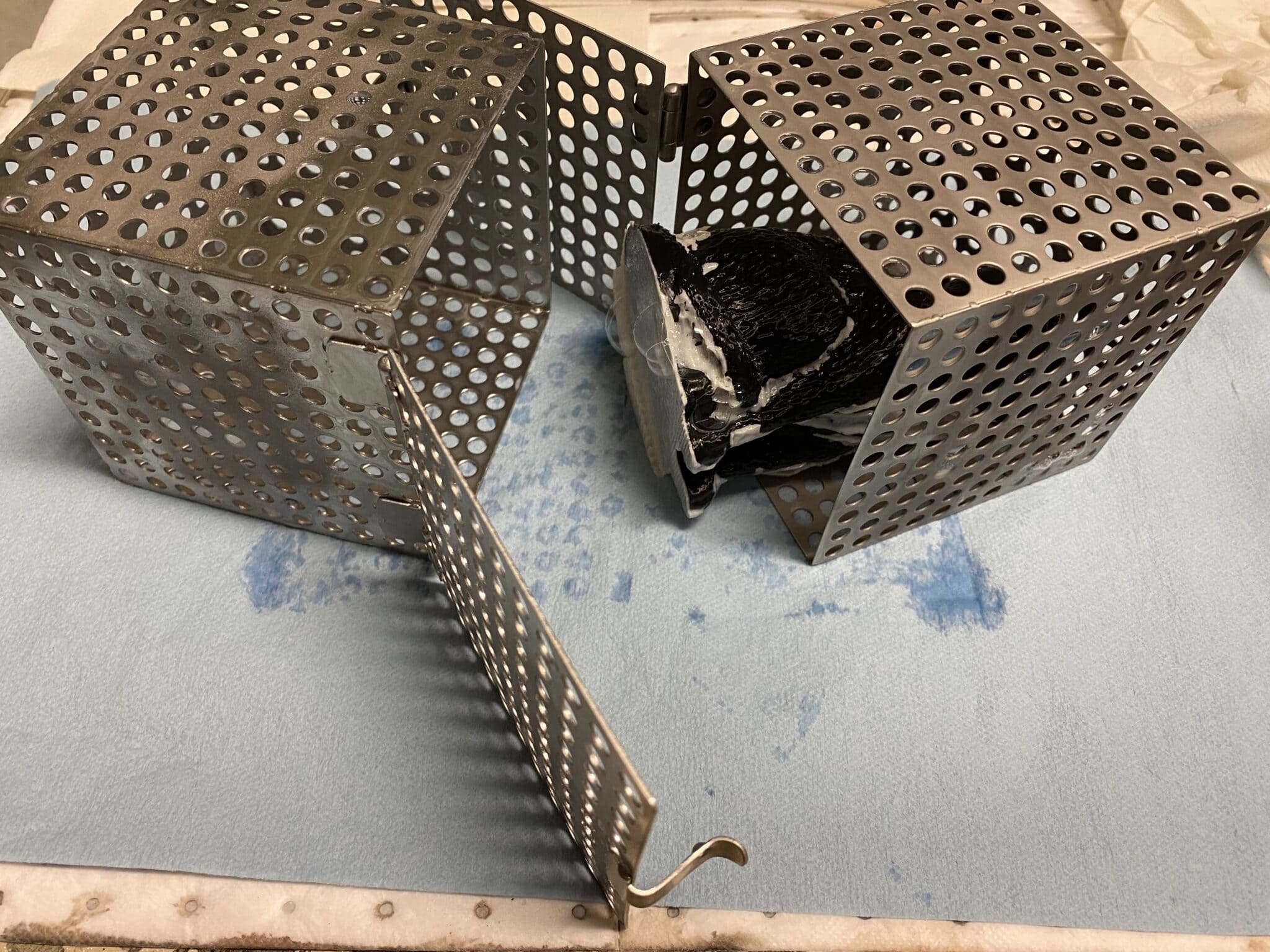
Two small perforated metal boxes, which will be snapped together to make a single, larger box for holding a 3D printed part while its support material is dissolved in sodium hydroxide.
Two small perforated metal boxes, holding a 3D printed part, and almost snapped together. The box will stay on the bottom of an SCA tank while the printed part's support material is dissolved in sodium hydroxide.
Two perforated small metal cube-shaped baskets, snapped together. They will hold a 3D printed part and keep the part from floating while support is being dissolved in an SCA tank.

Load your part into one 4-inch cube but keep the lid open. Then snap the latch of the opened lid from one cube onto the top-edge of a second cube and repeat with the second lid snapped onto the opposite side. You now have a tank-box that is 4”x4”x8”. Place the double-cube into the SCA tank and watch it stay on the bottom, where full fluid-flow will reach all over it for the fastest clean-up time.

If your part is too large even for this approach, you can still convince a floating part to stay down deep. If your part has a hole in it, thread one end of a length of stainless-steel wire through that hole and twist the wire so it stays. Then thread the other end of the wire through any hole in the box, again twisting the end to stay in place. You’ve now converted the cube into an anchor that will hold your part down in the tank.

If there are no holes or slots in your part, wrap a longer piece of stainless-steel wire around the part itself, and then connect it through a hole in the cube to create the same anchor function.

Soluble supports for Stratasys filaments simplify printing complex geometries, so use these tips to simplify the support removal, too. If you’ve discovered other ways to achieve this goal (has anyone threaded SS nuts onto wire and wrapped it around a part?) please share it in the Comments.


CatPrint3cropped

PADT Inc. is a globally recognized provider of Numerical Simulation, Product Development and 3D Printing/3D Scanning products and services. For more information on Stratasys printers and materials contact us at info@padtinc.com.

Get Your Ansys Products & Support from the Engineers who Contribute to this Blog.

Technical Expertise to Enable your Additive Manufacturing Success.

Share this post:

Upcoming Events

Apr 21
, 2026
Reduce Component Weight in Demanding Service Conditions - Webinar
Apr 22
, 2026
Certification by Analysis for Propulsion Systems: Building Confidence through Modeling, Uncertainty, and Credibility - Webinar
Apr 22
, 2026
Modeling a Pressurized Water Reactor in Flownex - Webinar
Apr 22
, 2026
Ansys 2026 R1: Ansys Discovery What’s New
Apr 23
, 2026
Access the Right Material Data Directly Inside Your Simulation Workflow - Webinar
Apr 23
, 2026
Ansys 2026 R1: Ansys Digital Twin What’s New
Apr 27
- Apr 30
, 2026
Nuclear and Emerging Technologies for Space (NETS) 2026
Apr 28
, 2026
Uncertainty Quantification for Real‑World Model Deployment in Industrial Systems - Webinar
Apr 28
, 2026
Ansys 2026 R1: Ansys Sherlock and Electronics Reliability What’s New
Apr 29
, 2026
Ansys 2026 R1: Structural Mechanics What’s New
Apr 30
, 2026
Ansys 2026 R1: What’s New in Ansys Optics
May 07
, 2026
Ansys 2026 R1: Ansys LS-DYNA What's New
May 13
, 2026
2026 Arizona Manufacturing Showcase
Jun 18
, 2026
E-Mobility and Clean Energy Summit
Jul 15
, 2026
Arizona Aerospace Summit
Aug 10
- Aug 11
, 2026
2026 CEO Leadership Retreat + Golf Tournament
Oct 21
, 2026
2026 Southern Arizona Tech + Business Expo
Nov 18
, 2026
2026 Governor’s Celebration of Innovation

Contact Us

Most of our customers receive their support over the phone or via email. Customers who are close by can also set up a face-to-face appointment with one of our engineers.

For most locations, simply contact us: